
Technical Selection Parameters for Nonwoven Mesh Belts: CFM, Weave, and Layering Explained
Three numbers on a nonwoven mesh belt data sheet decide most of the belt's running behaviour: air permeability (CFM), weave structure (written in the Above-X Below-Y format), and layer count. A 580±30 CFM belt with an Above-3 Below-5 weave and 1.5 layers — such as Yiheng Mesh's HB4106 — behaves very differently from a 750±30 CFM, Above-6 Below-6, 2.5-layer belt such as K6012, even though both are ordered under the same category name, “nonwoven mesh belt.” This guide explains what each parameter controls, how each number is measured, and how to convert them into a specification your supplier can quote against.
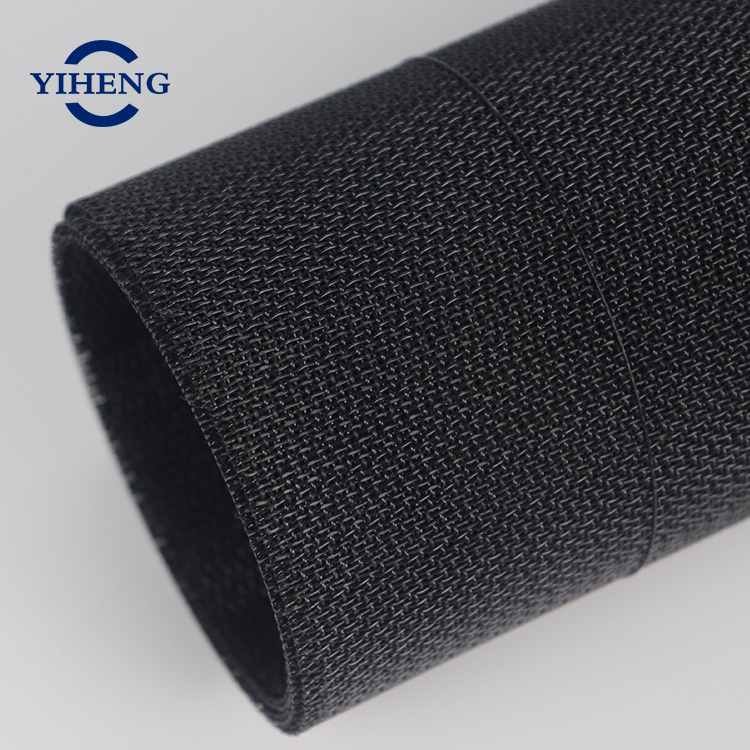
Antistatic nonwoven mesh belt — the three selection parameters (CFM, weave structure, layer count) are printed on every Yiheng Mesh model sheet.
“Nonwoven mesh belt” is a category, not a specification
Two belts can carry the same category name and still differ in thickness by more than a millimetre, in air permeability by a factor of four, and in the pressure basis used to measure that permeability. The mismatch does not appear on the purchase order; it appears weeks later on the line, as a fabric defect.
In Yiheng Mesh's published troubleshooting knowledge base, the most common forming-belt complaints map back to a parameter that was never fixed at the ordering stage:
- Fiber hanging and longitudinal streaks — fiber penetrates the mesh gaps. Root causes documented by the manufacturer include excessive lower suction pulling fiber into the gaps, a CFM that is too high for the denier being run, and polymer burrs or lumps on the mesh surface catching fiber.
- Cloudy spots and uneven fabric weight — local CFM variation changes the suction pressure distribution during web formation and disrupts fiber flow.
- Fabric floating or flipping above roughly 400 m/min — static attraction, or cooling air volume exceeding suction lift.
- Roller jumping and transverse seam marks — a seam whose thickness does not match the mesh body creates a periodic impact as it passes the rollers.
The practical conclusion: a nonwoven mesh belt should be specified by process, CFM window, weave structure, layer count, joint type, and static class — not by category name and length.
What modern nonwoven lines demand from a forming belt
Nonwoven mesh belts provide the forming and conveying surface for spunlace, spunbond, and meltblown processes, and for the through-air section of airlaid lines. The documented working conditions for these applications are demanding: high line speed, high electrostatic environment, high temperature, precision web formation, and precise release, running in 24/7 continuous cyclic operation. The matched equipment list for a typical forming section includes the spinneret, quench air system, filament drawing system, lay-down conveyor, calender, through-air dryer, compactor, and winder.
Published specifications for high-performance nonwoven forming belts list line speeds up to 1,000 m/min and operating temperatures up to 180°C, which sets the performance envelope that belt parameters must be selected against. On the market side, spunlaid technology — spunbond and meltblown combined — accounted for 48.4% of the global nonwoven technology market in 2023, according to Grand View Research, and Dataintelo reports the global nonwoven production line market at USD 5.3 billion in 2024, projected to reach USD 9.8 billion by 2033. As those lines get faster and thinner-fabric capable, parameter-level selection stops being an engineering formality and becomes the difference between stable GSM and constant cleaning downtime.
Parameter 1: air permeability (CFM)
What CFM actually measures
CFM is the unit of air permeability. It expresses the volume of air, in cubic feet, that passes through one square foot of mesh per minute under a defined pressure differential. Yiheng Mesh rates its forming and anti-static belts at 127 Pa per 20 cm², and that basis is printed on every model sheet — for example HB4106 at 580±30 CFM, K4106B at 700±30 CFM, and K6012 at 750±30 CFM.
Why the tolerance matters more than the nominal value
CFM governs fiber adhesion and web uniformity, which is why it is treated as the primary selection parameter. In air-laid and suction-based forming, the mesh acts as the filter medium in a gas-solid separation. Because flow through a porous medium is proportional to the pressure gradient, a locally high-CFM zone draws more fiber clusters while a low-CFM zone draws fewer, producing weight variation across the web. Yiheng Mesh controls air permeability fluctuation within a strict ±5% range through heat-setting, which is the physical basis for a consistent web.
Selection rule: when fiber hanging or longitudinal streaks appear and lowering suction does not settle the line, the documented remedy is to move to a more tightly woven mesh with lower CFM rather than to keep re-tuning suction air.
The unit trap: 127 Pa/20 cm² versus 100 Pa
Not every Yiheng model is quoted on the same basis. The spunbond, spunmelt, and anti-static series are quoted in CFM at 127 Pa/20 cm², while the spunlace and airlaid series are quoted in m³/m²/h at 100 Pa — for example 07502 at 19,176 m³/m²/h and 41203 at 6,700 m³/m²/h. These numbers cannot be compared directly with a CFM figure because both the unit and the test pressure differ. When comparing two suppliers, always confirm the pressure basis first, then the value.
Parameter 2: weave structure (Above-X Below-Y)
Weave structure is written in the Above-X Below-Y format on Yiheng Mesh specification sheets. The two digits are the loom notation for the interlacing pattern and are used to distinguish structures that behave differently in terms of fiber holding and release, and they travel together with thickness and weight rather than independently of them.
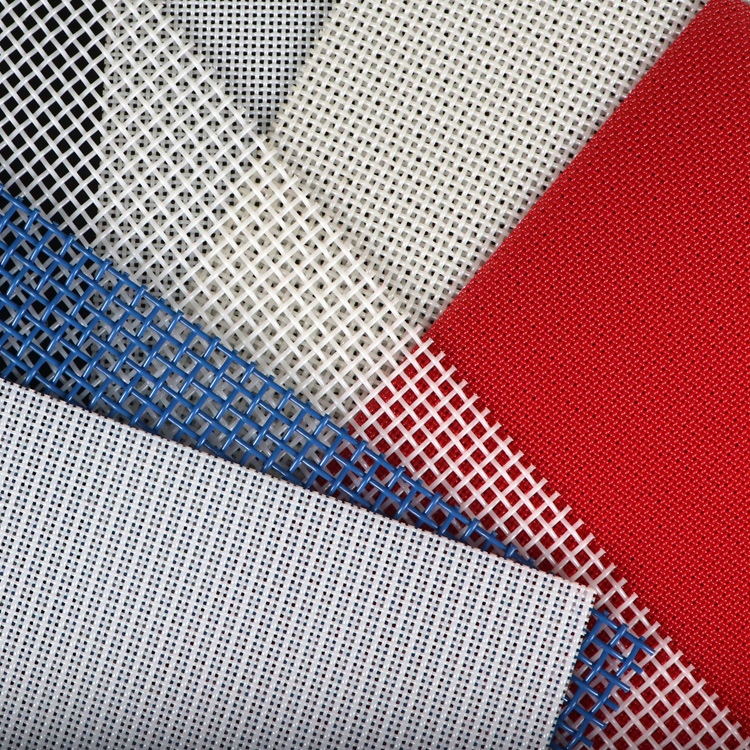
Square mesh weave close-up. The Above-X Below-Y designation on the model sheet describes the interlace pattern that produces this surface.
Across the current range, three structures cover almost every application:
- Above-3 Below-5 — the standard structure for the spunbond and anti-static series. It is used on HB4106, HY4106, K4106A, K4106B, SK604, and HY408S, with thicknesses between 1.65 mm and 1.93 mm.
- Above-4 Below-8 — specified on KJD700, which the manufacturer documents as delivering high adhesion, and which is intended for two-component and spunlace equipment.
- Above-6 Below-6 — used on K6012, the 2.5-layer belt built for high-speed lines and thin nonwoven fabric production.
The design intent behind the choice is a balance between adhesion and peelability. A structure that holds the web too aggressively will not release cleanly at the transfer point; one that releases too easily lets fiber pull away with the forming surface. SK604 is documented specifically as providing a good balance of adhesion and peelability for high-speed lines producing soft, thin, low-GSM fabric, which is the combination where this trade-off is hardest to hold.
Parameter 3: layer count, thickness, and weight
Layer count in the Yiheng range is either 1.5 or 2.5, and it is not a cosmetic label: it moves thickness, weight, and structural stiffness together. The 1.5-layer models — HB4106, HY4106, K4106A, K4106B, SK604, HY408S, and KJD700 — run between 1.65 mm and 2.34 mm thick and between 990 g/m² and 1,100 g/m². The single 2.5-layer model, K6012, is 2.8 mm thick at 1,200 g/m² and is specified for high-speed lines and thin nonwoven fabric production.
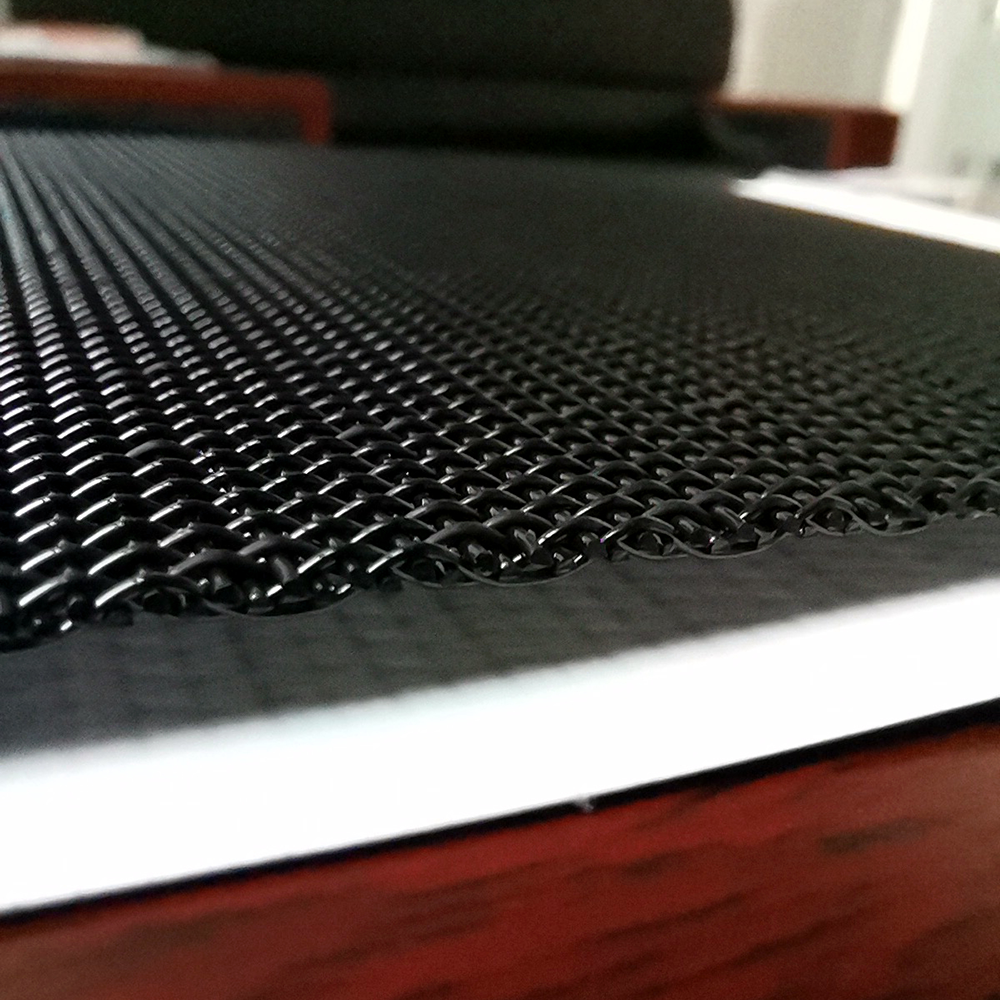
Cross-section of a forming belt. Layer count on the model sheet maps directly to the belt thickness and weight shown in the specification table below.
Filament cross-section is a fourth, closely related variable. HB4106 uses a flat warp (0.38 × 0.58 mm) on a 1.8 mm, 1,030 g/m² body; the flat profile creates a smoother micro-surface so fiber and contaminants do not penetrate deep into the mesh, which cuts cleaning downtime, and the flat cross-section also raises transverse stiffness. Round-filament belts such as HY4106 (red 0.50 mm warp, white 0.50 mm weft) are the general-purpose option for standard spunbond running.
Decision rule: if the belt is being replaced primarily because of cleaning downtime and frequent product changes, prioritise a flat-filament structure. If the replacement driver is load, tension, and dimensional stability on a high-speed line, prioritise layer count and thickness first.
Step-by-step: specifying a nonwoven mesh belt in five steps
- Fix the process and the fabric first. Spunbond, meltblown, spunlace, airlaid through-air, or two-component. This determines which series you are selecting from, because the spunbond/spunmelt range and the spunlace/airlaid range are quoted on different permeability bases.
- Set the CFM window and record the measurement basis. Confirm whether the value is stated at 127 Pa/20 cm² (CFM) or at 100 Pa (m³/m²/h), then confirm the tolerance — Yiheng quotes ±30 CFM on the forming series. A narrow, verified tolerance is what protects web uniformity.
- Match the weave structure to adhesion versus release. Above-3 Below-5 for standard spunbond and anti-static duty; Above-4 Below-8 where high adhesion is required on two-component and spunlace equipment; Above-6 Below-6 where the line runs fast and thin.
- Match layer count, thickness, and weight to the mechanical duty. 1.5 layers for standard forming duty; 2.5 layers where additional body and dimensional stability are needed. Also fix the dimensional tolerances at this stage: Yiheng quotes ±5 cm on lengths under 50 m and ±1 cm on widths under 5 m.
- Lock the joint, edge treatment, and static class. Joint options across the range include self-ring, millet-ring, and double-pins; high-speed models use double-pins with a flat seam surface to prevent fiber snagging and roller jumping. Welding edges typically carry 2 cm glue brushing on both sides, with melt glue or AB glue used on SK604. Static class is selected from the conductivity values published per model.
Where the parameters matter most: five line scenarios
1. High-speed hygiene lines running soft, thin, low-GSM fabric
SK604 is the match here: 700±30 CFM, Above-3 Below-5, 1.5 layers, 1.85 mm, 1,030 g/m², double-pins joint, and a 10⁶ Ω conductivity value, documented as suitable for high-speed lines with a good balance of adhesion and peelability. HY408S is the alternative where a three-filament hybrid weft is preferred; it runs 680±30 CFM with a 10⁵–10⁶ Ω conductivity range at 1,100 g/m².
2. Static-critical, low-GSM and two-component / spunlace equipment
KJD700 carries the highest anti-static grade in the range at 10³–10⁴ Ω and is specifically engineered for two-component (ES) fiber and spunlace equipment. Its Above-4 Below-8 structure provides high adhesion, and the double-pins joint keeps a flat seam surface to prevent fiber snagging at speed.
3. Lines that need extra structural body
K6012 uses a 2.5-layer, Above-6 Below-6 construction at 2.8 mm and 1,200 g/m², with 750±30 CFM and an air permeability documented as reaching 12,000 m³/m²/h with an energy-saving airflow structure. It is specified for high-speed lines and thin nonwoven fabric production.
4. Ultra-fine spunlace webs
41203 is the ultra-thin option at 0.3 mm, with a 103 mesh count, 40 ends/cm warp density, and 6,700 m³/m²/h at 100 Pa, designed for super-thin, soft, high-density spunlace material. 60188 goes finer still at a 108 mesh count and 0.68 mm thickness, with 4,750 m³/m²/h at 100 Pa for maximum surface smoothness.
5. Airlaid and through-air drying sections
Here permeability dominates because the belt's job is to let hot air pass evenly. 07502 is the lightest in the hot-air series at 420 g/m² with an 18 mesh count, 1.0 mm pitch, and 19,176 m³/m²/h at 100 Pa. 05602 opens the mesh further — 14 mesh, 1.2 mm pitch, 19,676 m³/m²/h at 100 Pa — for thick, bulky, high-loft fabric. 06702 and 09502 sit between them for ordinary to fine-density hot-air production.
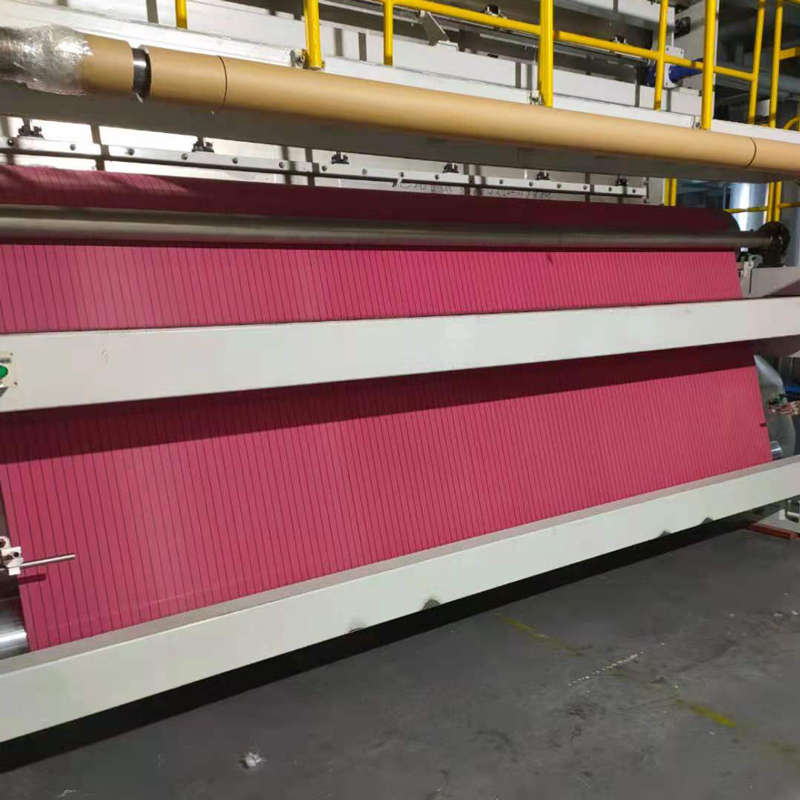
Forming belt in continuous production. Parameter choices show up as web uniformity, release behaviour, and cleaning frequency rather than as data-sheet values.
Parameter comparison: Yiheng forming and anti-static series (127 Pa/20 cm² basis)
| Model | Belt type | Air permeability | Weave structure | Layers | Thickness | Weight | Static / conductivity |
|---|---|---|---|---|---|---|---|
| HB4106 | Spunbond | 580±30 CFM | Above-3 Below-5 | 1.5 | 1.8 mm | 1,030 g/m² | Flat-filament warp 0.38 × 0.58 mm |
| HY4106 | Spunbond | 680±30 CFM | Above-3 Below-5 | 1.5 | 1.65 mm | 1,030 g/m² | Round PET, 0.50 mm warp / 0.50 mm weft |
| K4106A | Anti-static | 600±30 CFM | Above-3 Below-5 | 1.5 | 1.88 mm | 990 g/m² | 10⁶–10⁷ Ω |
| K4106B | Anti-static | 700±30 CFM | Above-3 Below-5 | 1.5 | 1.93 mm | 1,100 g/m² | 10⁵–10⁶ Ω |
| SK604 | Spunmelt | 700±30 CFM | Above-3 Below-5 | 1.5 | 1.85 mm | 1,030 g/m² | 10⁶ Ω |
| HY408S | Spunmelt | 680±30 CFM | Above-3 Below-5 | 1.5 | 1.85 mm | 1,100 g/m² | 10⁵–10⁶ Ω |
| K6012 | Spunmelt | 750±30 CFM | Above-6 Below-6 | 2.5 | 2.8 mm | 1,200 g/m² | Anti-hydrolysis + conductive PET |
| KJD700 | Spunmelt | 600±30 CFM | Above-4 Below-8 | 1.5 | 2.34 mm | 1,030 g/m² | 10³–10⁴ Ω |
Figures as published in Yiheng Mesh model specifications. Joint types across this group include self-ring, millet-ring, and double-pins; width tolerance ±1 cm under 5 m and length tolerance ±5 cm under 50 m.
Fine-mesh series comparison (100 Pa basis)
| Model | Series | Air permeability | Mesh count / pitch | Thickness | Weight |
|---|---|---|---|---|---|
| 05602 | Airlaid | 19,676 m³/m²/h | 14 mesh / 1.2 mm pitch | — | 560 g/m² |
| 07502 | Airlaid | 19,176 m³/m²/h | 18 mesh / 1.0 mm pitch | — | 420 g/m² |
| 06702 | Airlaid | 14,242 m³/m²/h | 16 mesh / 0.8 mm pitch | — | 1,000 g/m² |
| 09502 | Airlaid | 12,770 m³/m²/h | 23 mesh / 0.5 mm pitch | — | 650 g/m² |
| 41203 | Spunlace | 6,700 m³/m²/h | 103 mesh | 0.3 mm | — |
| 60188 | Spunlace | 4,750 m³/m²/h | 108 mesh | 0.68 mm | — |
Values in this table are quoted at 100 Pa and are not directly comparable with the CFM values in the previous table.
Frequently asked questions
What does CFM mean on a nonwoven mesh belt specification, and why is it checked first?
CFM is the unit of air permeability: the volume of air, in cubic feet, passing through one square foot of mesh per minute at a defined pressure differential. Yiheng Mesh quotes forming and anti-static belts at 127 Pa per 20 cm². It is the first parameter to check because it determines fiber adhesion and web uniformity — the suction that lays fiber onto the belt passes through the mesh, so a locally high-CFM zone draws more fiber and a low-CFM zone draws less, producing weight variation. Yiheng controls CFM fluctuation within ±5% through heat-setting, and the forming series carries a ±30 CFM published tolerance.
What does the weave structure “Above-3 Below-5” mean, and when should I ask for something different?
The Above-X Below-Y format is the loom notation used on Yiheng Mesh model sheets to identify the interlacing pattern of the belt. Above-3 Below-5 is the standard structure across the spunbond and anti-static range, used on HB4106, HY4106, K4106A, K4106B, SK604, and HY408S. Ask for a different structure when the duty changes: Above-4 Below-8 (KJD700) is specified where high fiber adhesion is required, on two-component and spunlace equipment; Above-6 Below-6 (K6012) is used on the 2.5-layer belt for high-speed lines and thin fabric. The structure is chosen as a balance between holding the web during forming and releasing it cleanly at the transfer point.
Do I need a 1.5-layer or a 2.5-layer nonwoven mesh belt?
Layer count moves thickness, weight, and stiffness together, so it should be matched to the mechanical duty. The 1.5-layer models in the Yiheng range are 1.65–2.34 mm thick at 990–1,100 g/m² and cover standard spunbond, anti-static, and spunmelt forming duty. The 2.5-layer K6012 is 2.8 mm thick at 1,200 g/m² with an Above-6 Below-6 structure, and is specified for high-speed lines and thin nonwoven fabric production, where additional structural body and dimensional stability are the priority. If cleaning downtime is the main constraint rather than load, a flat-filament structure such as HB4106 (0.38 × 0.58 mm flat warp, 1.8 mm, 1,030 g/m²) is usually the more relevant change than layer count.
How can I verify a nonwoven mesh belt supplier can match my line before placing a production order?
Verify three things in sequence: parameter transparency, sampling capability, and applied experience. Parameter transparency means the supplier publishes CFM with its test basis and tolerance, weave structure, layer count, thickness, weight, joint type, and conductivity for each model, as Yiheng Mesh does for the SK, K, HY, HB, and numbered series. Sampling capability means the supplier can build a prototype to your line specification rather than only shipping a catalogue item — Yiheng works to a minimum order quantity of 1 m² with prototype sampling available in as little as 3 days. Applied experience means documented work on comparable equipment: Yiheng has supplied Reicofil, Chaolong, and Hongda equipment users and maintains a knowledge base of more than 122 real-world troubleshooting cases covering tracking, fiber hanging, static, and seam marks.
Are Yiheng nonwoven mesh belts compliant for EU delivery, and how long do they last?
Yes. Henan Yiheng Mesh Belt Industry Co., Ltd. holds the Food Contact Certificate for its products and is registered under the German Packaging Law (LUCID), which supports compliant delivery into European markets. On service life, Yiheng states that its mesh belts typically last 3–6 months under standard operating conditions, supported by high-wear-resistant materials; regular cleaning and tracking checks are recommended to extend that interval. To move from specification to confirmation, the fastest route is to send your line details, fabric GSM and denier, and target CFM basis to www.yhfilterbelt.com, or email ada@yhfilterbelt.com and request a sample or quotation.
Conclusion: turn three numbers into a line-fit specification
CFM sets how fiber behaves as it is laid down and how uniform the finished web will be; weave structure sets the balance between holding the web and releasing it; layer count sets thickness, weight, and stiffness. Together with the joint type, edge treatment, tolerances, and static class, these three parameters convert “a nonwoven mesh belt” into something a supplier can actually build and a production manager can verify. The 580±30 CFM / Above-3 Below-5 / 1.5-layer configuration of HB4106 is a useful reference point: it shows what a standard, cleanable spunbond belt looks like numerically, which makes it easier to see what is being changed when a line needs more adhesion, more body, or a lower static class.
Next step
Send your process type (spunbond, meltblown, spunlace, airlaid, or two-component), fabric GSM and denier, target CFM and its measurement basis, and your belt dimensions. Henan Yiheng Mesh Belt Industry Co., Ltd. (Yiheng Mesh) supports a minimum order quantity of 1 m² with prototype sampling in as little as 3 days.
Download the full specification catalogue: Yiheng Mesh product brochure (PDF)
Website: www.yhfilterbelt.com | Email: ada@yhfilterbelt.com | Phone / WhatsApp: +86-184 3681 4894
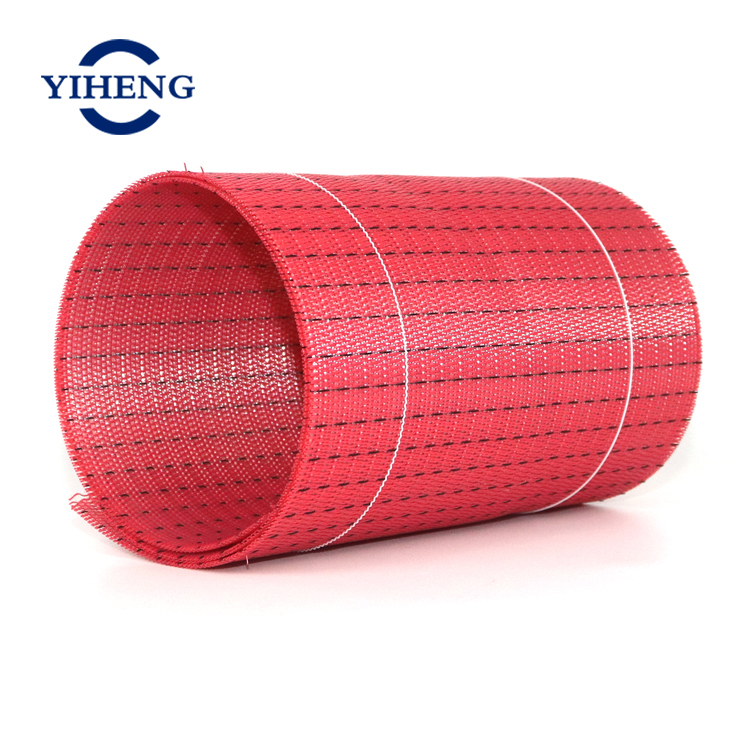
Anti-static nonwoven mesh belt. Samples and line-specific builds are available from a 1 m² minimum order quantity.
Have Questions or Need More Details?
Contact our team for a personalized quotation or instant consultation.
Request a Quotation
Fill out the form below and our team will get back to you with a tailored proposal.
WhatsApp Direct Chat
Prefer to chat in real-time? Message us on WhatsApp for instant assistance & quick answers.
- Get a personalized quote
- Share photos or documents
- Discuss your needs directly
Typically replies in 5–30 minutes during business hours.