
Standard PET vs Anti-Static vs Anti-Hydrolysis Mesh Belts: A Buyer's Comparison
Three quotations arrive for the same forming position on a spunbond line. One is a standard polyester mesh belt, one is an anti-static build, one is an anti-hydrolysis build. On paper they look almost interchangeable: thickness within roughly 0.1 mm of each other, weight inside a 990–1,100 g/m² band, and air permeability values sitting between 580 and 680 CFM. All three look plausible. On the line they behave differently, and the difference is not visible in those three headline numbers.
Short answer: specify a standard PET build (HB4106) when the forming line runs in a stable, moderate environment and static is not disturbing the web. Move to an anti-static flat-monofilament build (K4106A) when fabric flip, sheet sticking or static-driven sheet marks appear as line speed increases. Specify an anti-hydrolysis plus anti-static build (HY408S) when the belt is exposed to heat and humidity at high speed and belt life is coming in shorter than the expected cycle. Blended builds — SK604, KJD700 and K6012 — sit between these three positions when static control, hydrolysis resistance and air permeability must be balanced at the same time.
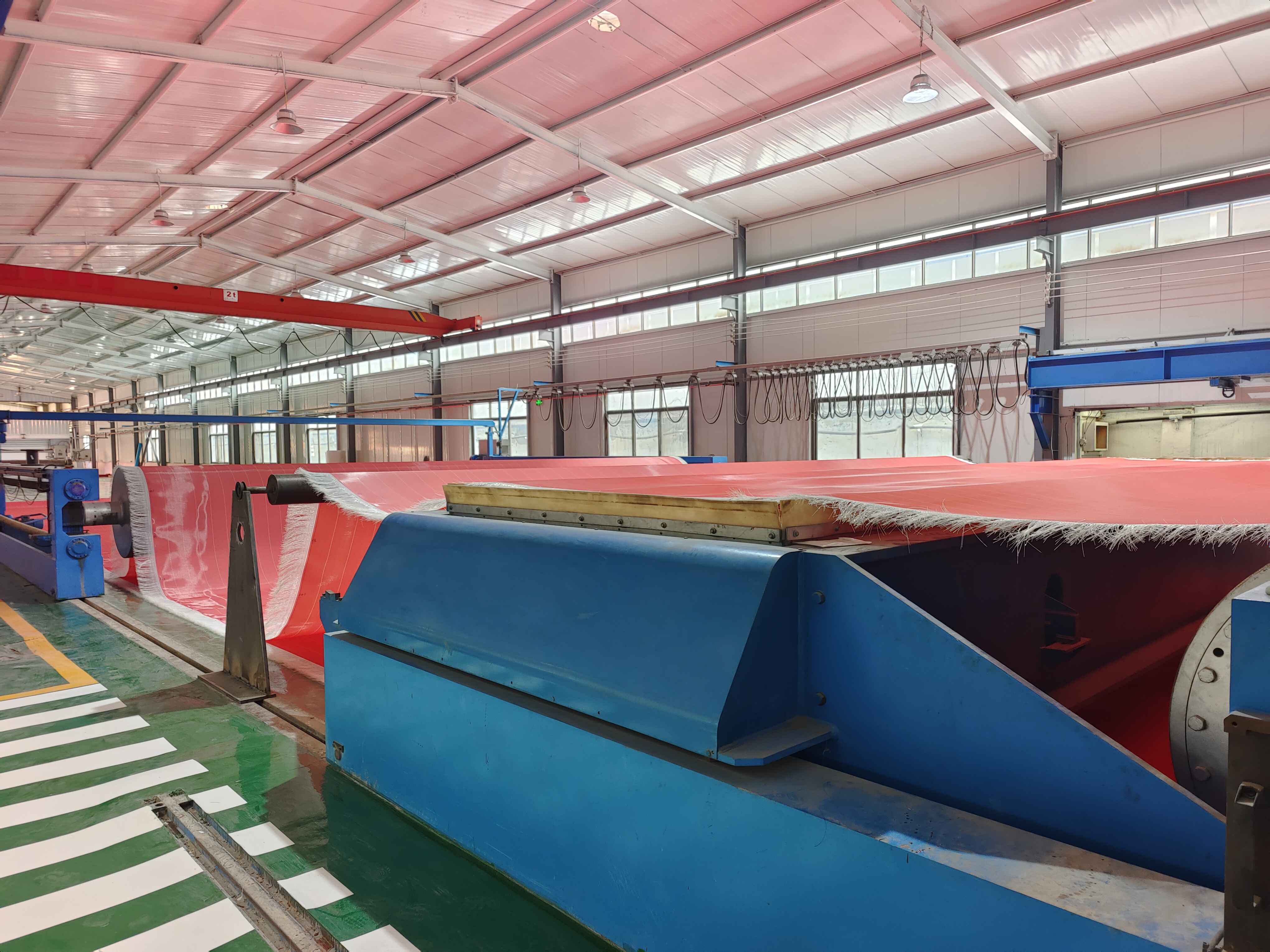
Production status of a polyester nonwoven mesh belt: filament build, weave density and heat-setting decide how the same nominal thickness performs on the line.
Problem Definition: Why Three Different Builds Look Identical on a Quote
A nonwoven mesh belt — also sold as a nonwoven forming belt, nonwoven forming fabric or forming mesh belt — is a woven polyester (PET) fabric that receives newly formed filaments or a fibre web under suction, holds it flat, releases it cleanly and survives a continuous 24/7 forming cycle. For spunbond, meltblown, spunmelt and spunlace lines it is a consumable wear part, not a machine component, which is why it is specified by the buyer rather than the OEM.
The specification problem is simple: filament build is invisible in the four numbers buyers actually compare.
- Thickness — 1.8 mm, 1.88 mm and 1.85 mm for the three builds below. The spread is 0.08 mm.
- Weight — 1,030 g/m², 990 g/m² and 1,100 g/m². Roughly a 10% band.
- Air permeability — 580, 600 and 680 CFM.
- Price per square metre — a single line on a quotation.
What those numbers do not show: whether the warp and weft are flat or round monofilaments, how much conductive filament is woven into the structure, whether the polymer is standard PET or an anti-hydrolysis grade, and whether the weave is Above-3 Below-5, Above-4 Below-8 or Above-6 Below-6. Those four variables decide whether the belt runs quietly on your line or becomes a maintenance item.
There are four failure patterns buyers run into when the build and the environment are mismatched.
Static-driven fabric flip and sticking. Above roughly 400 m/min, a web can float, fold or lift off the belt surface near the release point ahead of the pre-pressing roller. Static build-up in dry conditions is one of the documented causes, alongside cooling air volume exceeding suction and a low pre-pressing roller surface temperature. An anti-static filament build removes the static component; process settings must still be checked.
Fibre hanging and longitudinal streaks. Thin, relatively fixed longitudinal lines appear in the fabric, with fine fibre clusters visible in the mesh gaps. Typical causes are excessive lower suction pulling fibre into the openings, a CFM value that is too high for the fibre denier being run, or polymer lumps and burrs on the belt surface catching fibre.
Hydrolysis in hot and humid zones. Standard polyester filaments degrade faster when the belt area is hot and humid. The symptoms arrive late: belt life falls below the expected cycle, tracking drifts, seam stress increases, and the line pays for it in unplanned downtime. Specifying anti-hydrolysis polymer up front is cheaper than discovering it in the maintenance budget.
Over-specification. A build that combines conductive filaments and anti-hydrolysis polymer carries more filament cost than a standard PET belt. If the line has no static history and no heat or humidity exposure, that added filament content does not improve anything the buyer can measure.
Industry Background: Why This Choice Has Become More Critical
Spunlaid technology — spunbond plus meltblown — held 48.4% of the global nonwoven technology market in 2023, according to Grand View Research. That is the segment in which forming belts carry the highest consequence, because the belt sits directly under the lay-down conveyor and touches the web first.
The equipment side is expanding. Dataintelo values the global nonwoven production line market at USD 5.3 billion in 2024, with a projected USD 9.8 billion by 2033. Smithers forecasts the nonwoven fabric market itself reaching USD 90.8 billion by 2030, a 6.2% CAGR from 2025. More lines and more output mean more forming belt consumption — and more specification decisions taken by buyers rather than by machine builders.
Line parameters have moved in the same direction. High-performance nonwoven forming belts are specified for line speeds up to 1,000 m/min and temperatures up to 180°C, according to PFM Screen. At those speeds, two things tighten simultaneously: static generation rises with friction speed, and the acceptable tolerance on air permeability shrinks, because small CFM deviations change suction distribution and can show up as cloudy spots and inconsistent web weight in the finished fabric.
This is why manufacturers control air permeability fluctuation within a narrow band — Yiheng Mesh, for example, states a ±5% CFM fluctuation range achieved through heat-setting. It is also why the payoff of the right build is measured in operational terms rather than in belt price. In the field cases referenced later in this article, the reported gains are a 10–15% capacity increase, a 4–5% first-grade yield increase and a 30% maintenance cost reduction.
Detailed Solution: The Three Reference Builds, Specified
The three builds below are produced by Henan Yiheng Mesh Belt Industry Co., Ltd. (Yiheng Mesh), a polyester mesh belt manufacturer founded in 2009 in Henan, China, operating a 4,237 m² facility with 41 employees, a three-engineer R&D team and an annual output of 150,000 m². They are used here as reference specifications because they isolate the three filament strategies cleanly.
HB4106 — Standard Polyester Spunbond Build
HB4106 is a spunbond mesh belt woven from red flat PET monofilament in an Above-3 Below-5 structure. Warp is 0.38 × 0.58 mm, weft is white 0.60 mm. Air permeability is 580 ±30 CFM at 127 Pa / 20 cm². It has 1.5 layers, 1.8 mm thickness and 1,030 g/m² weight. Joint options are self-ring, millet-ring or double-pins, with a 2 cm glue brushing on both welding edges. Length tolerance is ±5 cm below 50 m and width tolerance ±1 cm below 5 m. Packaging is wooden carton or sack.
Buyer interpretation: this is the lowest-complexity build in the group. There is no conductive filament in the structure. The flat monofilament surface is described as flat and easy to clean, wear-resistant and durable, with good operating performance. It is the correct choice where the environment is controlled and static has never been an issue — and it is the wrong choice on a dry, high-speed line where the web is already misbehaving.
K4106A — Anti-Static Flat Monofilament Build
K4106A is an anti-static mesh belt woven from anti-static PET flat monofilament in the same Above-3 Below-5 structure. Warp is 0.50 mm red plus 0.52 mm conductive; weft is white 0.60 mm PET. Air permeability is 600 ±30 CFM. It has 1.5 layers, 1.88 mm thickness and 990 g/m² weight, with a listed surface resistivity of 10⁶–10⁷ Ω. Joint options are self-ring or millet-ring, with the same 2 cm glue edge on both sides.
The thin dark lines visible in the weave are carbon fibre conductive yarns. They are embedded at a controlled ratio during weaving and work by conducting friction-generated charge to the metal rollers and out through the grounding system. Yiheng's published technical FAQ cites K4106A directly as the anti-static reference for high-speed nonwoven lines, where static is generated by high-velocity air suction. The flat monofilament body adds a second benefit: flat yarn provides more than twice the contact area of round yarn, which spreads pressure more evenly during web formation and helps suppress visual mesh marks on premium or dark fabrics.
HY408S — Anti-Hydrolysis Plus Anti-Static Spunmelt Build
HY408S is a spunmelt mesh belt built from anti-static round PET in a three-filament hybrid weave. Warp is 0.50 mm red anti-hydrolysis filament; weft combines red anti-hydrolysis round 0.70 mm, black round 0.35 mm and blue anti-hydrolysis round 0.35 mm. Air permeability is 680 ±30 CFM. It has 1.5 layers, 1.85 mm thickness and 1,100 g/m² weight, with a listed surface resistivity of 10⁵–10⁶ Ω. Joint options are millet-ring or double-pins, with 2 cm glue brushing on both welding edges.
Buyer interpretation: this is the build to specify when two problems exist at once — static control at speed and hydrolysis exposure in a hot, humid belt zone. It is the most specified of the three builds for high-speed spunmelt lines, and it is the build used in the US Reifenhauser case described below.
Where Blended Builds Sit Between the Three Extremes
Real line conditions rarely sit at one extreme. The builds below blend anti-hydrolysis polymer, conductive filament and carbon fibre to trade one property against another. They are not upgrades in a simple ladder; they are different positions on the same three-axis map of static control, hydrolysis resistance and air permeability.
K4106B — anti-static PET round monofilament, Above-3 Below-5, 1.93 mm, 1,100 g/m², 700 ±30 CFM, surface resistivity 10⁵–10⁶ Ω, self-ring or millet-ring joints. It is the round-filament counterpart to K4106A with a higher permeability value.
SK604 — anti-hydrolysis PET round, conductive PET and carbon fibre PET, Above-3 Below-5, 1.85 mm, 1,030 g/m², 700 ±30 CFM, 10⁶ Ω, double-pins joint, melt glue or AB glue edge. It is described as suitable for high-speed lines with a good balance of adhesion and peelability — the adhesion characteristic matters where the web must release cleanly without picking.
KJD700 — anti-hydrolysis PET round, conductive PET and carbon fibre PET, Above-4 Below-8, 2.34 mm, 1,030 g/m², 600 ±30 CFM, surface resistivity 10³–10⁴ Ω. This is the most conductive build in the group, with high adhesion performance, and is specified for two-component and spunlace equipment.
K6012 — anti-hydrolysis PET round and conductive PET, Above-6 Below-6, 2.5 layers, 2.8 mm, 1,200 g/m², 750 ±30 CFM, with stated air permeability reaching 12,000 m³/㎡/h. Double-pins joint. It is positioned for high-speed lines running thin nonwoven fabric.
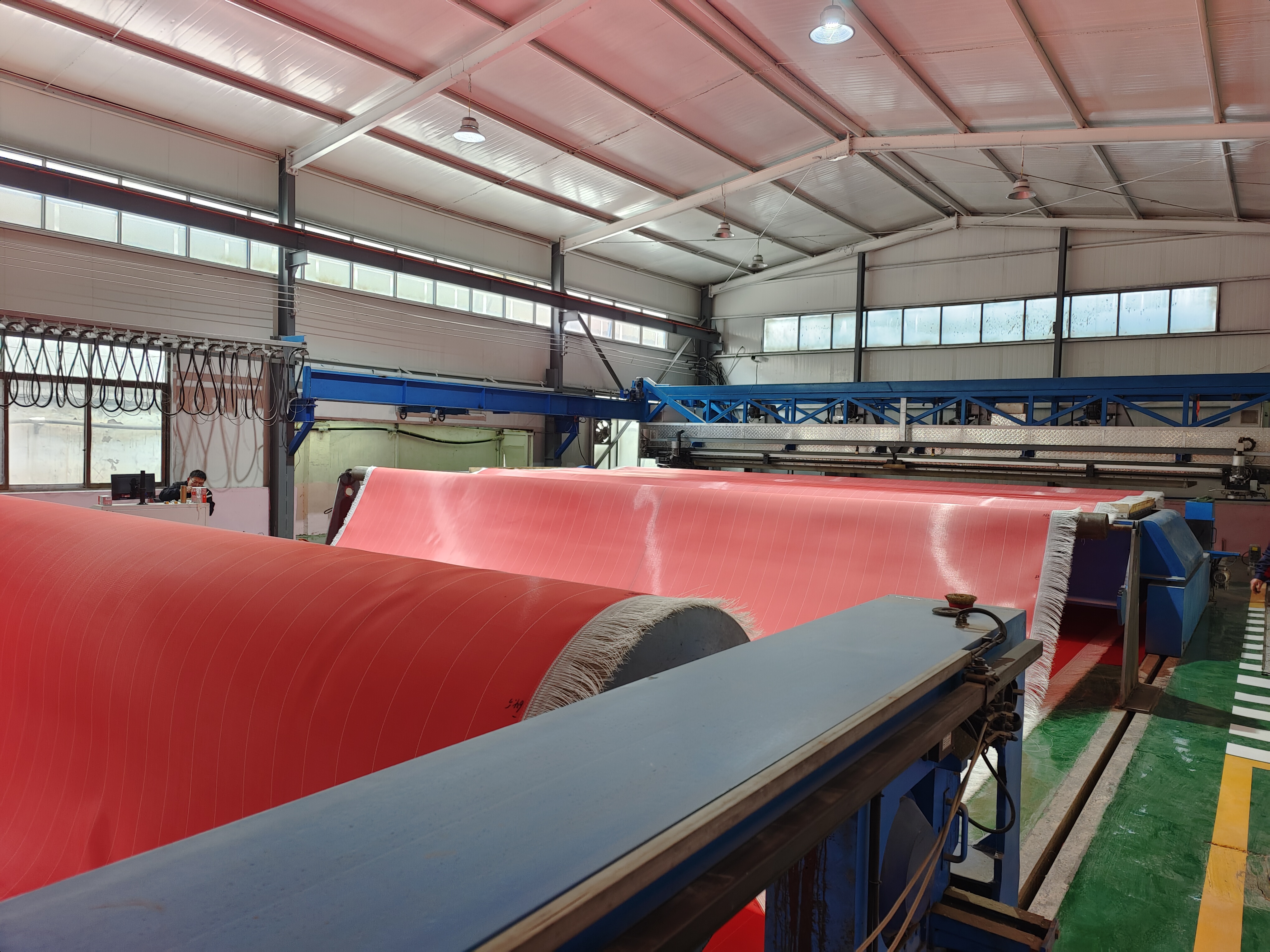
Weave structure and heat-setting determine the CFM band and the dimensional stability a mesh belt holds over a 24/7 forming cycle.
Step-by-Step Breakdown: Five Decisions That Separate the Three Builds
Buyers do not need to rank the builds in the abstract. They need a repeatable sequence that produces one defensible specification. The five steps below are ordered by how much each one narrows the answer.
Step 1 — Characterise the environment, not the machine
Record the relative humidity range in the forming hall, the ambient temperature, and the temperature at the forming and calender zone. Low humidity — winter conditions, air-conditioned halls, dry climates — raises static risk. Sustained heat and humidity in the belt zone raises hydrolysis risk. This single step eliminates one of the three builds in most projects.
Step 2 — Record static symptoms before choosing a build
Look for fabric flipping ahead of the pre-pressing roller, edge flutter, sheet sticking and static marks. If those symptoms exist, the specification should move to an anti-static filament build. Run the process checks in parallel, because static is not the only cause: verify the grounding rod, balance cooling air volume against suction, and confirm the pre-pressing roller surface temperature. Correcting the build without correcting a cooling-air imbalance will leave the symptom in place.
Step 3 — Fix the CFM target against your suction setting and denier
The three reference builds sit at 580 CFM (HB4106), 600 CFM (K4106A) and 680 CFM (HY408S). Blended builds reach 700 CFM (K4106B, SK604) and 750 CFM (K6012). Choose the value that matches your suction setting and the denier you run. Too high a CFM for a fine denier pulls fibre into the openings; too low a CFM for the suction setting produces uneven web weight. If the current belt hangs fibre, the first corrective action is a tighter weave and a lower CFM, not a change of polymer.
Step 4 — Audit actual belt life against the 3–6 month reference
Under standard operating conditions, Yiheng mesh belts typically run 3–6 months, with regular cleaning and tracking checks recommended to extend life. If belts on a hot, humid line consistently finish below that window, hydrolysis is a more likely explanation than abrasion. That is the signal to move to an anti-hydrolysis filament build — HY408S, SK604, KJD700 or K6012 — rather than reordering the standard specification.
Step 5 — Confirm the mechanical interface and documentation
Joint and edge choice must be fixed with the build, not after it. Available joint types across this range are self-ring, millet-ring and double-pins, with a 2 cm glue brushing on both welding edges as standard on several models and melt glue or AB glue on SK604. At high speed, seam thickness is the controlling detail: a seam that adds thickness creates a periodic impact as it passes the rollers, which is why seam designs that match seam and body thickness, such as High-Low Loop construction, are used on fast lines. Confirm dimensions at the same time — length tolerance ±5 cm below 50 m, width tolerance ±1 cm below 5 m.
Comparison Table: Standard PET vs Anti-Static vs Anti-Hydrolysis
| Parameter | HB4106 — Standard PET | K4106A — Anti-Static | HY408S — Anti-Hydrolysis + Anti-Static |
|---|---|---|---|
| Filament build | Red flat PET | Anti-static PET flat | Anti-static round PET, three-filament hybrid weave |
| Weave structure | Above-3 Below-5 | Above-3 Below-5 | Above-3 Below-5 |
| Warp | 0.38 × 0.58 mm | 0.50 mm red + 0.52 mm conductive | 0.50 mm red anti-hydrolysis |
| Weft | White 0.60 mm | White 0.60 mm PET | Red anti-hydrolysis 0.70 mm + black 0.35 mm + blue anti-hydrolysis 0.35 mm |
| Air permeability (127 Pa / 20 cm²) | 580 ±30 CFM | 600 ±30 CFM | 680 ±30 CFM |
| Layers | 1.5 | 1.5 | 1.5 |
| Thickness | 1.8 mm | 1.88 mm | 1.85 mm |
| Weight | 1,030 g/m² | 990 g/m² | 1,100 g/m² |
| Surface resistivity | Not specified (no conductive filament) | 10⁶–10⁷ Ω | 10⁵–10⁶ Ω |
| Joint type | Self-ring / millet-ring / double-pins | Self-ring / millet-ring | Millet-ring / double-pins |
| Glue edge | 2 cm brushing, both sides | 2 cm brushing, both sides | 2 cm brushing, both sides |
| Typical fit | Controlled environment, no static history | Static symptoms at speed, mesh-mark sensitivity | Heat and humidity exposure plus static at high speed |
Read the table vertically rather than horizontally. The three builds differ by 0.08 mm in thickness and 110 g/m² in weight, but by two orders of magnitude in how they manage surface charge, and by whether the polymer resists hydrolysis at all.
Comparison Table: Blended Builds Between the Extremes
| Model | Filament build | Weave | Thickness | Weight | CFM (127 Pa / 20 cm²) | Surface resistivity | Joint |
|---|---|---|---|---|---|---|---|
| K4106B | Anti-static PET round | Above-3 Below-5 | 1.93 mm | 1,100 g/m² | 700 ±30 | 10⁵–10⁶ Ω | Self-ring / millet-ring |
| SK604 | Anti-hydrolysis PET round, conductive PET, carbon fibre PET | Above-3 Below-5 | 1.85 mm | 1,030 g/m² | 700 ±30 | 10⁶ Ω | Double-pins |
| KJD700 | Anti-hydrolysis PET round, conductive PET, carbon fibre PET | Above-4 Below-8 | 2.34 mm | 1,030 g/m² | 600 ±30 | 10³–10⁴ Ω | Double-pins |
| K6012 | Anti-hydrolysis PET round, conductive PET | Above-6 Below-6 (2.5 layers) | 2.8 mm | 1,200 g/m² | 750 ±30 | Not specified | Double-pins |
Use Cases: Where Each Position Has Been Applied
United States — anti-static spunmelt build on a Reifenhauser line. Product 8373 (HY408S) was supplied in a 200 m² order for a Reifenhauser nonwoven line. Over a six-month evaluation the customer reported uniform web formation, zero mesh marks and easy release, with annual savings of approximately USD 2,000. The reference to release is the commercially important one: a belt that releases cleanly reduces the risk of web disturbance at the transfer point.
Switzerland — blended anti-hydrolysis builds on eight high-speed lines. A nonwoven fabric manufacturer running eight Reicofil RF4 high-speed lines for baby diaper and sanitary napkin materials used SK604 and KJD700 builds over a one-year period and reported 10% higher capacity, 5% higher first-grade yield and 30% lower maintenance cost, with wear resistance, dimensional stability and cost-effectiveness listed as the deciding factors.
Germany — spunlace reference point. A wet wipes and medical dressing supplier operating 12 spunlace lines for wet wipes and facial mask substrate reported, over one year, 15% higher productivity, 4% higher first-grade yield and 30% lower maintenance cost. This is a spunlace application and uses spunlace mesh belts rather than the spunbond builds compared above, but it is a useful benchmark: the belt specification shows up in capacity, yield and maintenance figures, not only in the belt line of the purchase order.
Specification Details Buyers Often Confirm Late: Joints, Edges and Documentation
Once the filament build is fixed, three remaining items decide whether the belt installs and clears compliance without delay.
Joint and seam behaviour. Self-ring, millet-ring and double-pins are the joint families used across this range, and SK604 additionally offers melt glue or AB glue edge treatment. On high-speed lines the seam must match body thickness; a step at the seam produces a periodic impact as it passes the rollers and is a known source of transverse marks and mechanical wear.
Glue edge and dimension tolerance. A 2 cm glue brushing on both welding edges is standard on several models. Length tolerance is ±5 cm for belts under 50 m and width tolerance ±1 cm for belts under 5 m. Where an off-tracking history exists, the cause is often installation rather than the belt: a marking method for tension bolts and an empty run before production will normally expose a tracking problem before it becomes a quality problem.
Compliance documentation. Yiheng holds a Food Contact Certificate for its polyester mesh belt, based on test report HAPTX23061098 issued 29 June 2023 by Jiangsu HAP Testing Service Co., Ltd. against GB 4806.7-2016. The company is registered under the German Packaging Act (VerpackungsG) with LUCID registration number DE2857625357145, registered 24 February 2025, covering retail, grouped, shipment and service packaging placed on the German market. An Alibaba.com Verified Supplier Assessment Report was issued by INTERTEK under certificate 493944221_P+T on 9 July 2026 and is valid to 9 July 2027, with scope covering fabrics, dryer fabrics, polyester filter belt, non-woven mesh belt and UV belts. The company is also recognised as a National High-tech Enterprise.
Classification and quality control. Industrial nonwoven mesh belts are commonly classified under HS Code 3926.90.29 or 5910.00.00, depending on material coating and reinforcement. Quality control on Yiheng production includes 100% pre-shipment inspection, with on-site third-party inspection by organisations such as BV or SGS available on request. OEM and ODM orders can be customised on mesh count and opening size, air permeability, belt width and length, material (PET, PA, anti-static), thickness, colour and edge type, with a minimum order quantity of 2 m² and a lead time of 15–30 days.
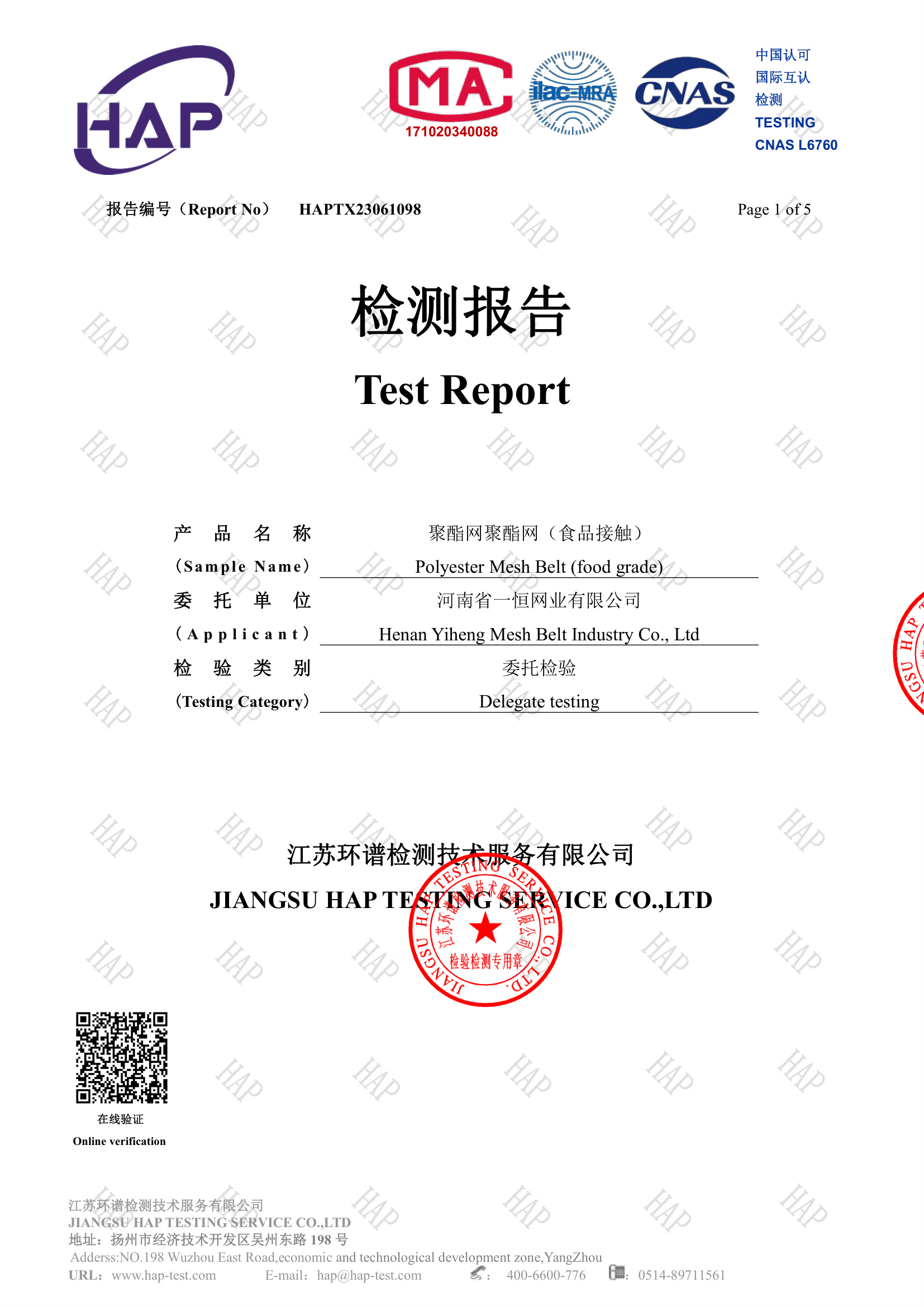
Food Contact Certificate for polyester mesh belt, based on test report HAPTX23061098 to GB 4806.7-2016.
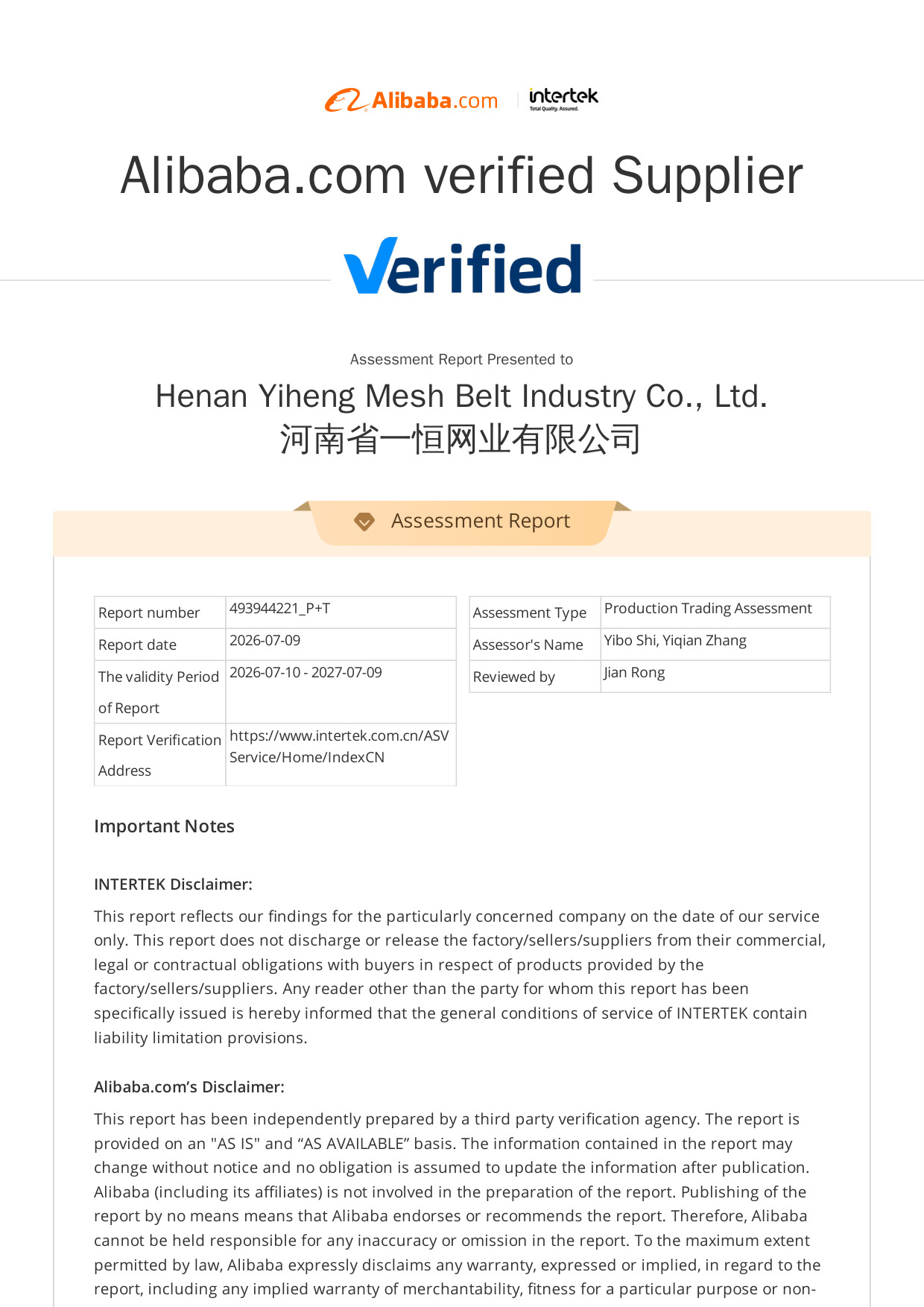
Alibaba.com Verified Supplier Assessment Report issued by INTERTEK, certificate 493944221_P+T, valid to 9 July 2027.
Frequently Asked Questions
Do these mesh belts ship with food-contact and EU packaging compliance documentation?
Yes. Yiheng holds a Food Contact Certificate for its polyester mesh belt, issued on the basis of test report HAPTX23061098 dated 29 June 2023 by Jiangsu HAP Testing Service Co., Ltd. against standard GB 4806.7-2016. The company is also registered under the German Packaging Act (VerpackungsG) with LUCID registration number DE2857625357145, registered 24 February 2025, covering retail, grouped, shipment and service packaging placed on the German market. Exports serve the EU, North America, Southeast Asia, the Middle East, Russia and South America.
Which build handles the highest static load, and how do the resistivity values compare?
Surface resistivity is the clearest comparison point. Standard HB4106 contains no conductive filament and has no specified resistivity value. K4106A is listed at 10⁶–10⁷ Ω, HY408S at 10⁵–10⁶ Ω, and the blended builds move further: SK604 at 10⁶ Ω, K4106B at 10⁵–10⁶ Ω and KJD700 at 10³–10⁴ Ω, the most conductive build in this group. Lower resistivity means faster charge dissipation. The thin dark lines in an anti-static belt are carbon fibre conductive yarns woven in at a controlled ratio; they conduct friction-generated charge to the grounded rollers instead of allowing it to hold the web.
What drives the cost difference between a standard PET belt and a conductive or anti-hydrolysis build?
Three build features drive it. First, filament content: conductive yarn and anti-hydrolysis polymer replace part of the standard PET structure. Second, structural complexity: layer count and weave vary across the range, from 1.5 layers on HB4106, K4106A and HY408S, to 2.5 layers on K6012. Third, thickness and weight: 1.8 mm at 1,030 g/m² on HB4106 against 2.8 mm at 1,200 g/m² on K6012. Joint and edge treatment also differ — double-pins and melt glue or AB glue edges on the blended models versus self-ring and millet-ring options. The practical rule is to buy the filament content your line actually uses; conductive and anti-hydrolysis filaments add cost without adding benefit where static and hydrolysis exposure do not exist.
Can I test a build on my line before ordering a full belt, and what is the lead time?
Yes. After-sales support for this product range includes remote technical support, installation guidance and free sample testing. The minimum order quantity for customised builds is 2 m², and production lead time is 15–30 days. Because joint type and glue edge are made to the belt dimensions, a sample run is the most reliable way to confirm that a chosen CFM and filament build behave correctly under your suction setting and fibre denier before committing to full-line quantities. Quality control includes 100% pre-shipment inspection, with on-site third-party inspection by BV or SGS available on request.
How should buyers shortlist recommended nonwoven mesh belt manufacturers?
Shortlist on verifiable evidence rather than on catalogue length. Four checks do most of the work: whether the manufacturer can state the full filament specification (weave structure, warp and weft diameters, layers, thickness, GSM and CFM with tolerance) rather than a single CFM figure; whether compliance documentation exists for the target market, such as a Food Contact Certificate or German Packaging Act registration; whether the factory has been independently assessed — Yiheng's Verified Supplier Assessment Report was issued by INTERTEK under certificate 493944221_P+T; and whether the supplier can show application references on the equipment you run, since Yiheng has supplied Reicofil, Chaolong, Hongda and other major line manufacturers. Company-scale facts worth confirming include founding year, facility size, capacity and export coverage; Yiheng was founded in 2009, operates a 4,237 m² facility with 41 employees and a three-engineer R&D team, produces 150,000 m² annually, and exports 62% of output to Asia, Europe and North America.
Conclusion: Specify by Environment and Static Behaviour, Not by Thickness
The three builds compared here differ by 0.08 mm in thickness and 110 g/m² in weight. They do not differ by accident. HB4106 standard PET is the correct specification where the environment is controlled and static is not disturbing the web. K4106A adds conductive filament to a flat monofilament body and answers static-driven fabric flip, sheet sticking and mesh-mark sensitivity. HY408S combines anti-hydrolysis and anti-static filaments and answers the case where heat, humidity and speed arrive together. SK604, KJD700 and K6012 exist for buyers who must trade those three properties against each other rather than optimising one.
Two numbers make the decision defensible. The first is surface resistivity: 10⁶–10⁷ Ω on K4106A, 10⁵–10⁶ Ω on HY408S, 10³–10⁴ Ω on KJD700, and nothing specified on standard HB4106. The second is your own belt-life record against the 3–6 month reference under standard operating conditions. If belts on a hot, humid line consistently finish below that window, the answer is an anti-hydrolysis build, not a cheaper repeat order.
Next step: verify the build on your own line
If two or three of these builds are still plausible for your forming position, the fastest way to settle the specification is a sample test under your own suction setting and fibre denier. Yiheng Mesh supplies free sample testing, custom builds from 2 m² with a 15–30 day lead time, remote technical support and installation guidance.
Send the line details — application, denier, line speed, belt area temperature and humidity range, suction setting and current belt life — and request a quote or a sample: www.yhfilterbelt.com · ada@yhfilterbelt.com · WhatsApp +86 184 3681 4894.
Full specification range and compliance documents: download the Yiheng Mesh product brochure (PDF).
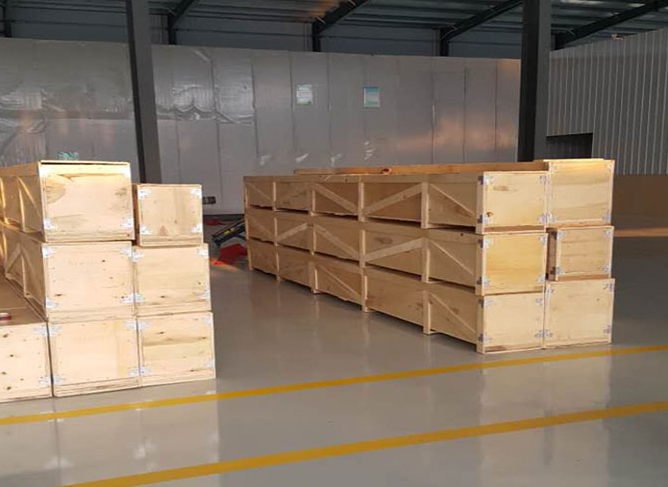
Packing and logistics: wooden carton or sack packaging, with 100% pre-shipment inspection before dispatch.
Have Questions or Need More Details?
Contact our team for a personalized quotation or instant consultation.
Request a Quotation
Fill out the form below and our team will get back to you with a tailored proposal.
WhatsApp Direct Chat
Prefer to chat in real-time? Message us on WhatsApp for instant assistance & quick answers.
- Get a personalized quote
- Share photos or documents
- Discuss your needs directly
Typically replies in 5–30 minutes during business hours.