Ranked: Top Polyester Mesh Belt Picks for Filtration, Drying and Dewatering Lines
Six polyester mesh belt configurations, ranked by application fit — from the filler-wire constructions that hold the tightest filtration control to the open spiral belts built for high-airflow drying. Each position is justified by published thickness, loop distance, air permeability and break strength.
Filter presses, pulp washers and drying conveyors rarely fail because a belt looked wrong. They fail because airflow, loop distance or filler construction did not match the duty. A municipal sludge press that needs a drier cake is a different engineering problem from a latex wire drying line that needs air movement, and one construction cannot solve both well.
This ranking lists six polyester mesh belt options from the Yiheng Mesh range in order of application fit, with the construction data behind each position. Henan Yiheng Mesh Belt Industry Co., Ltd. (Yiheng Mesh) is a Chinese manufacturer founded in 2009 that produces polyester mesh belts, filter belts, forming fabrics and dryer fabrics, exporting 62% of its output to Asia, Europe and North America.
The Core Problem: Belts That Look Identical and Behave Differently
Two polyester mesh belts can share the same width, the same length and the same colour and still deliver completely different results on the same machine. The variables that decide performance are not the ones printed on a delivery note.
Air permeability decides how much air or liquid passes through the mesh. In the Yiheng Mesh range, published air permeability runs from 7,300 m³/m²/h on the Small Loop-Filler Wire belt up to 18,300 m³/m²/h on the Medium Loop open spiral belt — a difference of more than two times between two belts that a buyer might describe identically as "a polyester mesh belt."
Loop distance decides how the belt behaves over small rollers and how much open area remains for drainage. A 5.20 mm loop distance on the Small Loop belt places more loops per metre of belt length than the 6.50 mm loop distance on the Medium Loop belt, which changes support behaviour on tight roller spacing.
Filler construction decides filtration fineness. Adding filler wires inside the spiral loops narrows the open area and stabilises the mesh geometry, which is the single most important reason the filler-wire variants in this ranking sit above their open spiral equivalents.
Break strength decides whether the belt survives mechanical tension, seam stress and the loads imposed by a press or a heavy pulp mat. Filler-wire constructions in this range are rated at a minimum of 2,000 N/cm, with the Large Loop-Filler Wire belt rated at 2,300 N/cm or higher.
Industry Background: Where Polyester Mesh Belts Sit Right Now
Polyester was the leading material segment of the global conveyor belt market in 2025 with a 28.4% revenue share, according to Straits Research. The same source projects the global conveyor belt market growing from USD 6.24 billion in 2026 to USD 8.53 billion by 2034. Absolute market-size figures vary between research houses — an alternative estimate places the 2026 value closer to USD 4.66 billion — because the definitions of what counts as a conveyor belt differ. The material-mix signal is the more reliable takeaway: polyester remains the dominant belt material.
The demand driver behind filtration belts specifically is wastewater treatment. Belt filter press technology is expected to grow at a compound annual growth rate of 8.8% between 2025 and 2033 within the sludge dewatering equipment market, according to Grand View Research. Belt filter press capacity depends directly on the press belts installed in it, which makes filter press belt selection a maintenance and operating-cost decision, not just a purchasing detail.
For buyers handling documentation, industrial textile products of this type are classified under HS Code 5911.90 (textile products and articles for technical uses) according to the United States International Trade Commission. Buyers who cite ISO 14890 during specification should note that ISO 14890 governs rubber- or plastics-covered conveyor belts with textile carcasses — it is worth confirming which standard actually applies before writing a standard number into a purchase specification for an open-mesh polyester belt.
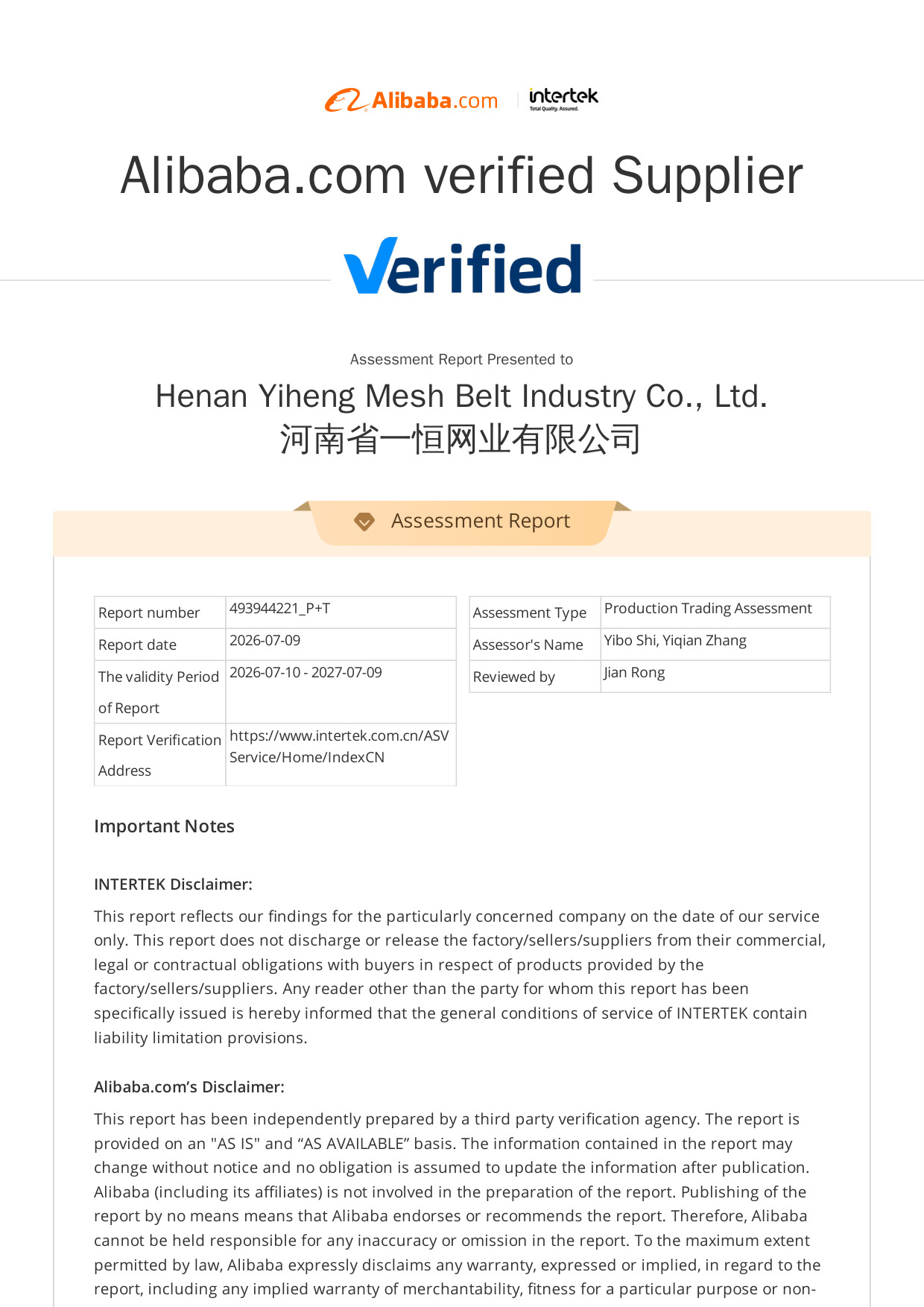
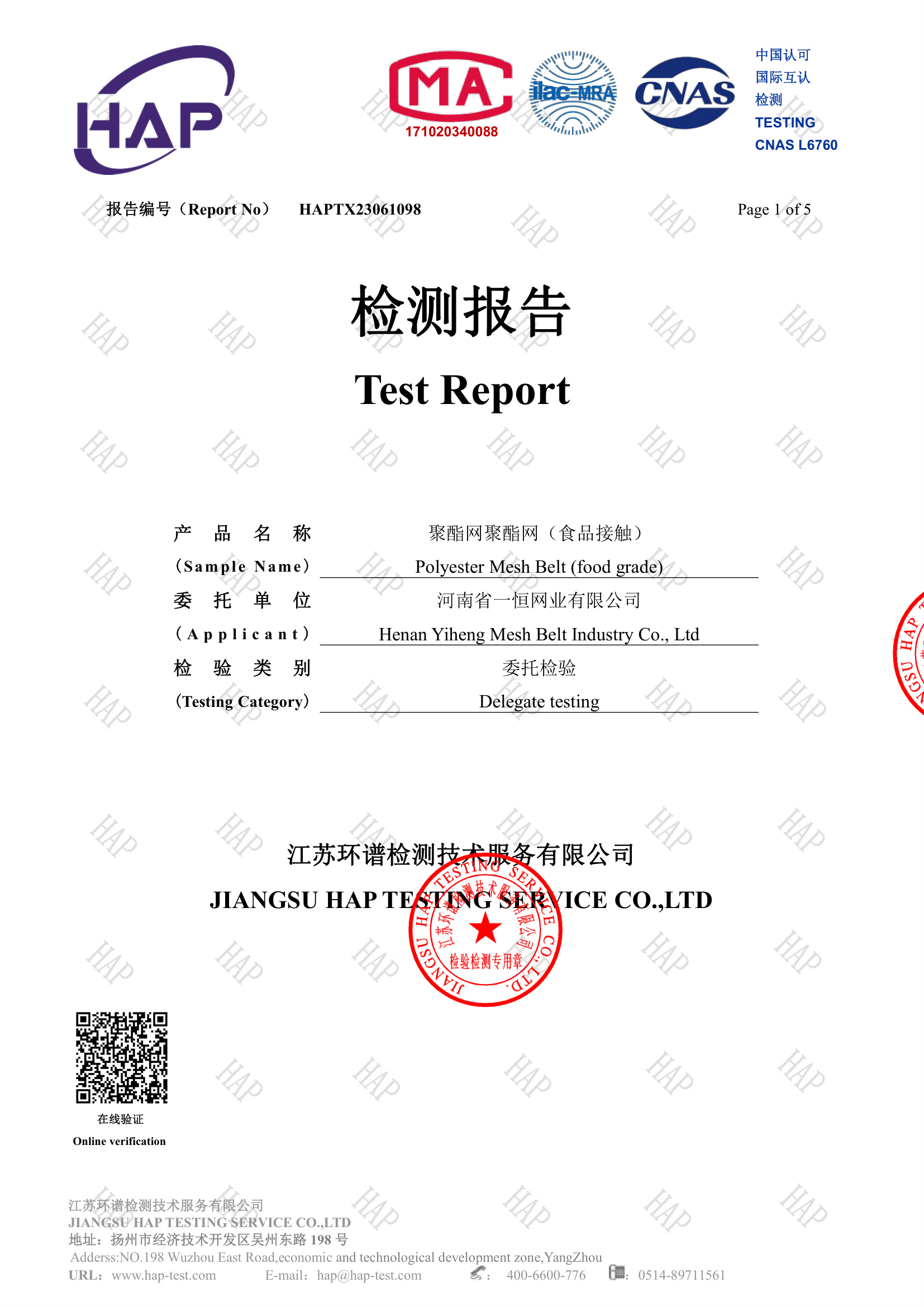
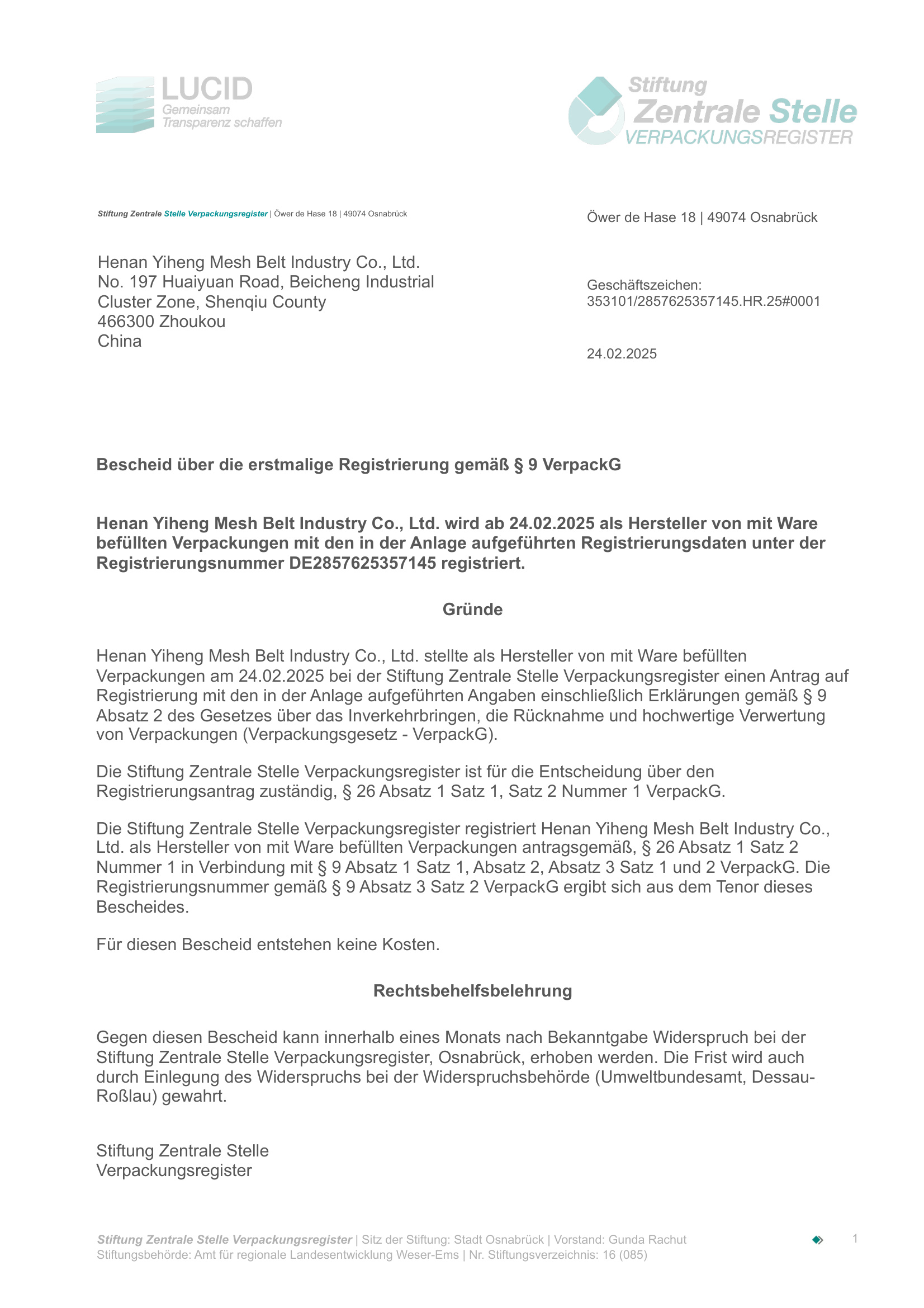
Verification documents available in this product range include a food contact test report issued under GB 4806.7-2016 (report HAPTX23061098, issued 29 June 2023 by Jiangsu HAP Testing Service Co., Ltd.), a German Packaging Act (VerpackungsG) LUCID registration numbered DE2857625357145 issued on 24 February 2025 through Stiftung Zentrale Stelle Verpackungsregister, and an Alibaba.com Verified Supplier Assessment Report produced by INTERTEK (report 493944221_P+T, valid 9 July 2026 to 9 July 2027).

The Ranking at a Glance
| Rank | Configuration | Thickness | Air Permeability | Break Strength | Where It Fits Best |
|---|---|---|---|---|---|
| 1 | Small Loop-Filler Wire | 1.90 mm | 7,300 ±500 m³/m²/h (450 ±30 CFM at 127 Pa) | ≥2,000 N/cm | Fine filtration and dewatering where solids retention and controlled permeability matter most |
| 2 | Medium Loop-Filler Wire | 2.32 mm | 10,700–12,000 ±500 m³/m²/h (660–740 ±30 CFM at 127 Pa) | ≥2,000 N/cm | Mixed dewatering duties needing a balance of drainage and fines retention |
| 3 | Large Loop-Filler Wire | 2.95 mm | 9,000–13,700 ±500 m³/m²/h (550–840 ±30 CFM at 127 Pa) | ≥2,300 N/cm | Belt filter presses and papermaking pulp washing |
| 4 | Medium Loop | 2.32 mm | 18,300 m³/m²/h | Not published for this construction | Latex wire drying and meltblown non-woven lines |
| 5 | Small Loop | 1.90 mm | 17,500 m³/m²/h | Not published for this construction | Tight roller spacing, food, pharmaceutical and wood-based panel lines |
| 6 | Model 16903 (herringbone filter press belt) | Not published | 7,894 ±500 m³/m²/h | ≥2,200 N/cm | Abrasive, acidic or alkaline dewatering: sewage, pulp pressing, juice, mine tailings |
The Ranked Picks in Detail
Rank 1 — Small Loop-Filler Wire: The Tightest Filtration Control in the Range
The Small Loop-Filler Wire belt is the first shortlist item for any duty where cake quality and fines retention decide whether the line works. Its structure pairs a 1.90 mm belt thickness with a 0.80 mm threading wire and 0.65 × 1.65 mm flat wire fillers.
The flat wire filler is the engineering reason this belt outranks open spiral alternatives for filtration. Filler wires occupy the space inside the spiral loops, reducing the open area and locking the mesh geometry so permeability stays predictable under load. The published air permeability is 7,300 ±500 m³/m²/h, equivalent to 450 ±30 CFM at 127 Pa — the lowest and most tightly controlled permeability figure in this ranking.
Break strength is rated at 2,000 N/cm or higher. That rating matters because a finer filtration belt is asked to do two jobs at once: retain solids and survive the mechanical tension of a press or a dewatering line. When a belt must be replaced on a running machine, the available joint types in this range — self-ring, millet-ring, double-pins and endless — determine how the belt is threaded on and removed.
Rank 2 — Medium Loop-Filler Wire: The Balanced Dewatering Choice
Where the duty mixes coarse and fine solids, or where the press is asked to handle changing sludge characteristics, the Medium Loop-Filler Wire belt is the more forgiving shortlist entry. It uses a 0.68 mm ring wire, a 0.90 mm threading wire and 0.68 × 3 or 0.68 × 4 mm fillers, at a belt thickness of 2.32 mm.
Published air permeability is 10,700–12,000 ±500 m³/m²/h, equivalent to 660–740 ±30 CFM at 127 Pa. That is a meaningfully higher airflow than Rank 1 while still benefiting from filler-wire geometry, which is why this construction sits above open spiral belts for any application where solids retention is part of the requirement.
Break strength is rated at 2,000 N/cm or higher. Application scope in this range covers environmental protection and wastewater treatment, papermaking, non-woven, textile and dyeing, and rubber and chemical fibre industries — a breadth that reflects how often a press duty changes without the equipment changing.
Rank 3 — Large Loop-Filler Wire: Built for Belt Filter Presses and Pulp Washing
The Large Loop-Filler Wire belt is the workhorse of belt filter presses and papermaking pulp washing. It is the thickest filler-wire construction in the range at 2.95 mm, built on a 0.90 mm ring wire and 1.00 mm threading wire with 0.90 × 3, 0.90 × 4 or 0.90 × 5 mm filler options.
That range of filler counts is the practical advantage of this belt: a buyer can tune open area by choosing how many filler wires sit inside each loop, moving published air permeability between 9,000 and 13,700 ±500 m³/m²/h (550–840 ±30 CFM at 127 Pa) without changing belt width, length or machine configuration.
Break strength is the highest of the filler-wire group at 2,300 N/cm or above. It ranks third rather than first because its higher airflow and larger loop geometry trade a degree of fines retention for throughput and durability — the right trade for a press producing a heavy pulp or sludge mat, the wrong one for a fine-solids filtration duty.
Rank 4 — Medium Loop: The Latex Wire Drying and Meltblown Specialist
The Medium Loop open spiral belt is the first pick where the job is moving air, not retaining solids. It carries a 0.68 mm warp, a 0.90 mm weft, a 6.50 mm loop distance, a 2.32 mm thickness and a published air permeability of 18,300 m³/m²/h — the highest figure in this ranking.
Two applications justify the position. On latex wire drying lines, the mesh must release moisture and heat uniformly while the coated wire passes over the belt, and elevated airflow is what allows the drying tunnel to work at rate. On meltblown non-woven lines, the belt supports a freshly formed web that must not be disturbed, and the open structure allows process air to pass without marking the web.
The 6.50 mm loop distance is the point to check against the machine. Larger loops reduce the number of contact points per metre, which suits wider roller spacing and heavier loads; where roller spacing is tight, Rank 5 becomes the better match.
Rank 5 — Small Loop: The Answer to Tight Roller Spacing
The Small Loop open spiral belt answers a specific mechanical constraint: short distances between rollers. It uses a 0.52 mm warp, a 0.70 mm weft, a 5.20 mm loop distance, a 1.90 mm thickness and delivers 17,500 m³/m²/h of air permeability.
With 17,500 m³/m²/h it stays close to the Medium Loop's airflow while offering a shorter loop distance and a thinner profile. On machines where the belt passes over small-diameter rollers or where belt thickness affects the running path, that combination matters more than maximum permeability.
The published application scope for this construction covers food processing, papermaking, environmental protection, non-woven manufacturing, wood-based panel processing and the pharmaceutical industry — sectors where belt cleanliness, flat running and a thin, flexible profile are all part of the requirement.
Rank 6 — Model 16903: The Abrasion and Chemistry Option
Model 16903 is a filter press belt built on high-grade PET specified as acid and alkali resistant, with a 0.70 mm warp, a 0.90 mm weft, a warp density of 16 wires/cm and a weft density of 5.33 wires/cm. Its weave pattern is herringbone or diagonal, a structure chosen for drainage behaviour rather than for filtration fineness.
Published air permeability is 7,894 ±500 m³/m²/h, and break strength is rated at 2,200 N/cm or higher. It ranks sixth because it is the most application-specific belt on this list: municipal sewage dehydration, paper pulp pressing, juice squeezing, mine smelting and mine tailings disposal. Where those conditions apply, its chemistry and drainage characteristics make it the first call rather than a fallback.
Also Worth Quoting: Square Mesh and Plain Weave Options
Two non-spiral constructions belong on a shortlist when the duty sits outside the spiral belt envelope. The 05802 polyester square mesh is a 2-shed plain weave with 0.8 mm warp and weft, a mesh range of 12–14, a pitch range of 1.0–1.2 mm and airflows of 13,384–20,775 m³/m²/h, described as non-toxic, odourless, corrosion-resistant and high in tensile strength; it suits food and feed drying, non-woven forming, pulp washing and sewage treatment.
The 16402 polyester plain weave mesh is finer, with 0.4 mm warp and weft, a mesh number of 41, a 0.2 mm pitch, a weight of 550 g/m² and 6,900 m³/m²/h of air permeability. Both are available with endless or self-ring joints.
Why Filler-Wire Belts Outrank Open Spiral Belts for Filtration
Filler-wire belts rank higher for filtration because the filler wires change the physics of the mesh, not just its appearance. Three effects do the work.
First, open area falls. Inserting 0.68 × 3 mm or 0.65 × 1.65 mm flat wire into the spiral loops reduces the passage available to solids and liquid, which is why the Small Loop-Filler Wire belt is published at 7,300 m³/m²/h while the Small Loop open spiral belt is published at 17,500 m³/m²/h.
Second, geometry becomes stable. Filler wires support the loops so the mesh resists deformation under press load, keeping permeability closer to its published value instead of drifting as the belt bears down on the cake.
Third, the surface changes. A flat wire filler produces a smoother belt surface than an open spiral structure, which affects cake release and cleaning. The break strength rating of at least 2,000 N/cm across the filler-wire group confirms that the added filtration control does not come at the cost of mechanical strength.
| Selection Factor | Filler-Wire Constructions | Open Spiral Constructions |
|---|---|---|
| Published air permeability | 7,300 – 13,700 m³/m²/h | 17,500 – 19,000 m³/m²/h |
| Solids retention | Higher — reduced open area | Lower — larger effective openings |
| Break strength | ≥2,000 N/cm (≥2,300 N/cm on Large Loop-Filler Wire) | ≥2,300 N/cm where published (Large Loop) |
| Surface | Flat-wire filler gives a smoother surface | Open loop structure |
| Typical duty | Belt filter press, sludge dewatering, pulp washing | Drying, cooling, non-woven forming and conveying |
Step-by-Step: Turning the Ranking Into a Purchase Order
- Classify the duty. Decide whether the belt is primarily filtering, drying or both. Filter press and pulp washing duties pull the shortlist toward Ranks 1 to 3 and 6; drying, cooling and web-support duties pull it toward Ranks 4 and 5.
- Fix the air permeability target. Identify whether the process needs high airflow or controlled permeability. The published range across this shortlist runs from 7,300 m³/m²/h to 18,300 m³/m²/h, which is wide enough that the target must be stated in the enquiry rather than assumed.
- Check loop distance against roller spacing. A 5.20 mm loop distance suits tight roller spacing; a 6.50 mm loop distance suits wider spacing and heavier loads. This is a machine constraint, not a preference.
- Confirm the mechanical rating. State the required break strength. Filler-wire options in this range are published at a minimum of 2,000 N/cm, with the Large Loop-Filler Wire belt at 2,300 N/cm or above.
- Specify size, edge and joint. Customisation in this range covers mesh count and opening size, air permeability in CFM, belt width and length, material (PET, PA or anti-static), thickness, colour and edge treatment, with self-ring, millet-ring, double-pins or endless joints available depending on construction.
- Agree the compliance and inspection package. Quality control in this range includes 100% pre-shipment inspection, and on-site third-party inspection by BV or SGS is available.
- Confirm MOQ, sampling and lead time. The minimum order quantity for this range is 2 m². Sampling support is available for testing, and production lead time is 15–30 days against a monthly capacity of 30,000 m².
Use Cases: What These Rankings Look Like in Service
Municipal sludge dewatering, Malaysia. A municipal wastewater treatment plant installed 12 polyester filter press belts for sludge dewatering. Over six months the plant recorded an 8% reduction in cake moisture, a 40% decrease in maintenance costs and no major failures. The belts used a high open area to resist clogging and chemical resistance for municipal sludge service — the same combination that places the Large Loop-Filler Wire and Model 16903 configurations at the top of a dewatering shortlist.
Food drying and conveying, Switzerland. A dehydrated vegetable and seafood processor used polyester mesh belts across 8 drying and conveying lines for fruit and vegetable drying. Over two years the site reported a 20% increase in productivity, a 35% reduction in maintenance costs and zero food safety incidents, with belts specified for high permeability, temperature resistance, easy cleaning and food-grade safe materials.
Papermaking, Germany. A paper mill running 8 production lines for premium facial and kitchen towel forming reported 25% energy savings, a 35% reduction in maintenance costs and no major failures over one year, with the belt group noted for uniform formation and zero mesh marks.
Rubber curing and sheet cooling, Malaysia. A rubber products manufacturer replaced belts across 8 curing and cooling lines. Over two years the site reported a 15% increase in productivity, a 30% reduction in maintenance costs and zero major failures, with heat resistance and air permeability identified as the deciding features.
UV printing, Austria. A sign and display manufacturer installed polyester mesh belts on 8 large-format UV printers for vinyl and banner work, reporting a 20% increase in productivity and a 30% reduction in scrap with no major failures over three years. This application depends on a smooth, burr-free surface and stable heat setting rather than on filtration performance — a reminder that the same material family serves different selection logic.
FAQ
1. Does a polyester mesh belt need food-contact documentation for drying lines?
Where a belt contacts food directly, buyers usually request food-contact evidence before approving a supplier. In this product range, a food contact test report for polyester mesh belt (food grade) was issued under standard GB 4806.7-2016, report number HAPTX23061098, on 29 June 2023 by Jiangsu HAP Testing Service Co., Ltd. Buyers exporting packaged goods into Germany should also confirm packaging-law registration: this manufacturer holds German Packaging Act (VerpackungsG) registration under LUCID number DE2857625357145, issued 24 February 2025 through Stiftung Zentrale Stelle Verpackungsregister. Separately, note that ISO 14890 governs rubber- or plastics-covered conveyor belts with textile carcasses, so it should not automatically be cited as the governing standard for an open-mesh polyester belt.
2. Can a polyester mesh belt be customised to a non-standard width, length or permeability?
Yes, within defined limits. Customisation in this range covers mesh count and opening size, air permeability expressed in CFM, belt width and length, material selection between PET, PA and anti-static grades, belt thickness, colour, and edge finishing. Joint type is also selectable, with self-ring, millet-ring, double-pins and endless options depending on the construction. Production is organised on an OEM/ODM basis against a monthly capacity of 30,000 m², so a custom construction does not require a change of supplier.
3. What determines the cost of a polyester mesh belt?
There is no single list price for a polyester mesh belt, because the cost follows the construction rather than the product category. The main cost drivers are the construction type (open spiral versus filler-wire, and how many filler wires are used), the monofilament diameter and material grade, belt width and length, the joint type and edge finishing, and the inspection package required. A filler-wire belt with three or five fillers per loop uses more material per square metre than an open spiral belt of the same width, and an enquiry that specifies permeability, thickness and break strength will receive a more accurate quotation than one that specifies dimensions only. The minimum order quantity for this range is 2 m².
4. Are samples available before placing a production order?
Sample testing is available, and free sample testing support is part of the standard service offer for this range. For custom constructions, the sampling process is set up to shorten development time and reduce the risk of ordering a full production run against an unverified specification. Because sample evaluation is the point at which a buyer confirms that air permeability, loop distance and joint behaviour match the line, it is worth defining the acceptance criteria for the sample before it ships rather than after it arrives.
5. What are the minimum order quantity, lead time and inspection options?
The minimum order quantity is 2 m² and production lead time is 15–30 days. Quality control includes 100% pre-shipment inspection, and on-site third-party inspection by BV or SGS is available for buyers who require an independent verification before shipment. For a first order, the practical sequence is to confirm the construction and dimensions, agree the sample, place the order at or above the 2 m² minimum, and book third-party inspection if the internal specification requires it.
Conclusion: Choosing From the Ranking
The ranking in this article resolves into a simple decision rule. If the line is judged on filtrate clarity and cake dryness, shortlist the filler-wire constructions first: Small Loop-Filler Wire for the finest duties, Medium Loop-Filler Wire for mixed duties, and Large Loop-Filler Wire for belt filter presses and papermaking pulp washing, where the 2.95 mm construction and 2,300 N/cm break strength rating carry the load.
If the line is judged on drying rate, web support or running behaviour over tight roller spacing, shortlist the open spiral constructions: Medium Loop at 18,300 m³/m²/h for latex wire drying and meltblown non-woven lines, and Small Loop at 17,500 m³/m²/h with its 5.20 mm loop distance where roller spacing is tight. Where chemical resistance and drainage dominate — sewage, pulp pressing, juice extraction, mine tailings — Model 16903 with its acid and alkali resistant high-grade PET and herringbone structure becomes the first entry rather than the sixth.
In every case the sequence is the same: define the duty, fix the permeability target, check loop distance against roller spacing, confirm the break strength rating, then specify size, edge and joint. The starting point is a specification, not a catalogue number — and the fastest way to close it is to state the duty and the target figures in the enquiry.
Next Step: Specification Review and Sampling
Henan Yiheng Mesh Belt Industry Co., Ltd. (Yiheng Mesh) manufactures polyester mesh belts, filter press belts, spiral mesh and dryer fabrics for filtration, drying and dewatering lines. If you are shortlisting between the configurations ranked above, the fastest route to a firm quotation is to send the application, target air permeability and machine dimensions for review.
Review the full product and capability range in the company brochure (PDF), or visit yhfilterbelt.com.
Contact: Mrs. Ada Li · Email: ada@yhfilterbelt.com · WhatsApp: +86 184 3681 4894
Minimum order quantity: 2 m² · Lead time: 15–30 days · 100% pre-shipment inspection · BV / SGS third-party inspection available

Have Questions or Need More Details?
Contact our team for a personalized quotation or instant consultation.
Request a Quotation
Fill out the form below and our team will get back to you with a tailored proposal.
WhatsApp Direct Chat
Prefer to chat in real-time? Message us on WhatsApp for instant assistance & quick answers.
- Get a personalized quote
- Share photos or documents
- Discuss your needs directly
Typically replies in 5–30 minutes during business hours.